Material cost
4x8 Plywood Sheet Cost Planner
Plan the cost of 4x8 plywood sheets with verified layout count, grade, delivery, sales tax, damaged-sheet allowance, and useful offcut value.
Research Lens
What should 4x8 plywood sheet cost planner confirm before material is purchased?
For DIY builders budgeting a sheet-good project, the useful answer is a project budget based on purchasable panels and visible assumptions. It starts by resolving what the project costs after the real sheet count and purchasing risks are known.
Decision Metrics
Visual model
Material cost: planning path
Move from verified dimensions to a reviewable layout, then confirm the cut sequence before material is committed.
Start With the Decision
A useful 4x8 plywood sheet cost planner is not a list of generic dimensions. For DIY builders budgeting a sheet-good project, it must answer what the project costs after the real sheet count and purchasing risks are known. Put that decision ahead of the first calculation so every measurement, allowance, and revision can be judged by whether it changes the real build.
Record the Inputs That Change the Result
Capture optimized sheet count, sheet grade, price per sheet, delivery, tax, defects, replacement risk, consumables, and offcut value. Keep field measurements separate from preferences and buffers. A clear input list makes it easier to revise one detail without silently changing every part in the plan.
Build a First Layout You Can Review
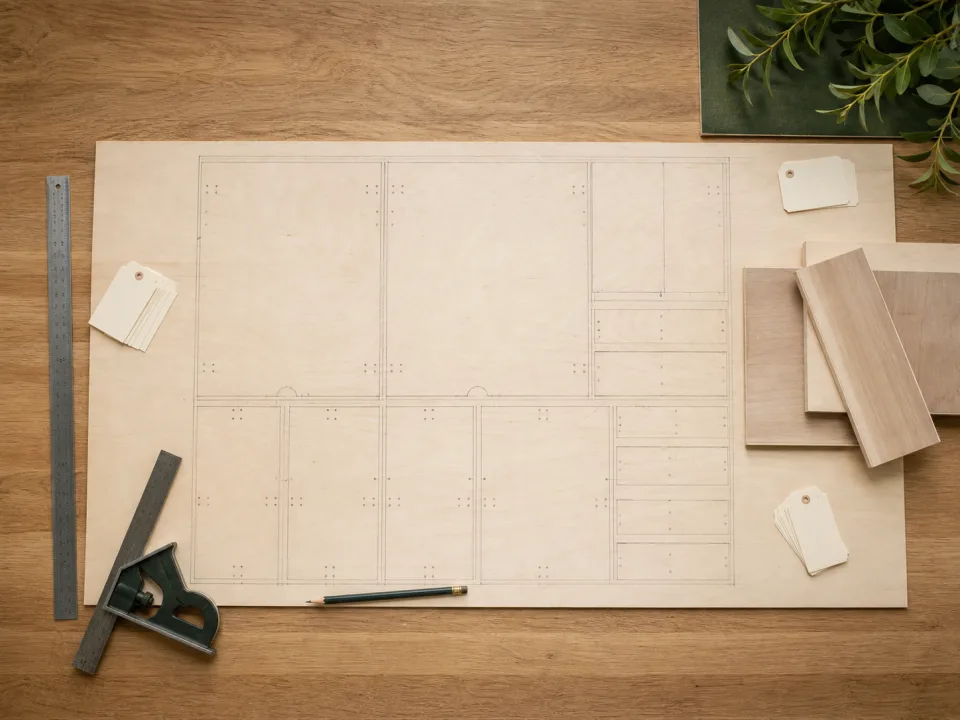
Use this sequence: confirm the sheet layout first, price the exact grade, then separate required cost from optional contingency and reuse value. Compare at least two reasonable options, then inspect the physical fit, visible faces, material groups, and cut order before treating a calculated result as final.
Prevent the Expensive Mistake
The common failure is pricing only the theoretical square footage while ignoring how sheets are sold and delivered. Catch it with a full-size check, one test piece, or a controlled review before sheets are ordered or a batch of parts is cut.
Turn the Layout Into Shop Work
Label parts by material group, keep a known reference edge, and work from the largest stable cuts toward smaller parts. A good diagram helps the operator make safe, traceable cuts; it does not replace handling judgment or tool instructions.
Save the Assumptions for the Next Revision
The target is a project budget based on purchasable panels and visible assumptions. Save the inputs, dimensions, material choice, kerf, and the reason for the selected option. Those notes make later edits faster and help identify why a new layout differs from the original.
Use the Right WoodCutTool Resources
Plywood Cutting Calculator helps turn this search into a reviewable calculation. Use 4x8 Plywood Cut List as the project-specific reference, then compare the final layout with the actual material and job conditions before cutting.
Compare
4x8 Plywood Sheet Cost Planner: what to check
| Stage | Purpose | Failure to catch | Best check |
|---|---|---|---|
| Measured inputs | Set the physical constraints | Assumed room or material dimensions | Measure the actual site and stock |
| First layout | Test material fit | Area totals that ignore rectangles and kerf | Review the full parts list on real sheet sizes |
| Shop review | Make the layout executable | Unlabeled parts, poor cut order, or unsafe handling | Check reference edges, support, and labels |
| Final revision | Preserve a useful record | Unexplained later changes | Save inputs and the selected option |
Field Checklist
- Define the decision: what the project costs after the real sheet count and purchasing risks are known.
- Record the real inputs: optimized sheet count, sheet grade, price per sheet, delivery, tax, defects, replacement risk, consumables, and offcut value.
- Keep material groups, kerf, and visible-grain rules separate.
- Prevent this error: pricing only the theoretical square footage while ignoring how sheets are sold and delivered.
- Finish with a project budget based on purchasable panels and visible assumptions.
FAQ
Common questions
What should a 4x8 plywood sheet cost planner include?
It should show the inputs that matter, the material groups, a physical-fit check, and the decision it supports: what the project costs after the real sheet count and purchasing risks are known.
Why is area math not enough?
Total area is a lower-bound estimate. Rectangles must fit within real sheet dimensions after kerf, trim, grain, and cut-sequence constraints.
When should the plan be checked again?
Recheck whenever a finished dimension, material thickness, sheet size, kerf, visible-grain rule, or part quantity changes.
When should I use Plywood Cutting Calculator?
Use Plywood Cutting Calculator when the rough parts list needs to become a visible, comparable material plan.
Sources